
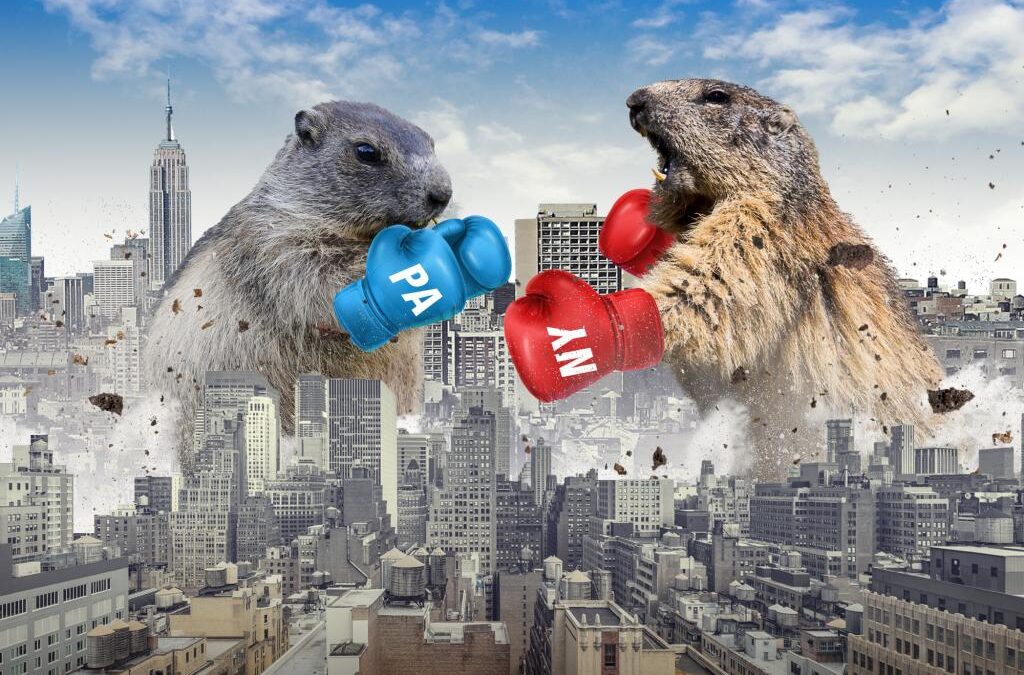
All other woodchucks stand in this guy’s shadow.
Legendary groundhog Staten Island Chuck is once again getting ready to make his famous Feb. 2 prediction — and he isn’t letting the fact that his forecasts are the most accurate in the business go to his head.
“This groundhog is very mellow. He’s a pretty low-key guy,” Cathy Eser, curator for the Staten Island Zoo, told The Post ahead of the Sunday’s Feb. 2 holiday celebrations.
There have been multiple generations of weather-predicting groundhogs who were eponymously called “Charles G. Hogg,” or “Chuck” for short, at the zoo since 1981 — along with some other charming marmots who have occasionally stood in as “Chuck” on the Feb. 2 holiday.
One — a female named Charlotte — met her tragic demise when then-Mayor Bill “Butterfingers” de Blasio dropped her in 2014. But over the years, they have all had one thing in common — a legendary propensity to more accurately tell if spring is coming than any other celebrity rodent around.
And the zoo’s current Chuck is no different.
“He’s used to the paparazzi!” said Jessica Hartmann, the zoo’s director of education.
“You come to the Staten Island Zoo, you want to see Staten Island Chuck. This one is a little bigger than usual, but he’s used to people crowding around him and [saying], ‘Hey Chuck, how you doing!’”
Chuck’s accuracy rate since the Staten Island Zoo started its Groundhog Day predictions is as high as 85%, according to the zoo — a hot streak that is incomparable to his much more famous, but more fallible competitor, Punxsutawney Phil.
That groundhog boasts just an overall 39% accuracy rate since starting the gig in 1887, according to StormFax Weather Almanac. The Pennsylvania whistlepig has only been right three times in the last decade, including last year.
Phil is also known to have a worse temperament and has refused to leave his dressing room for the annual show, with one mayor once describing the animal as “cranky.”
Chuck and his predecessors, over the years, have been much more “chill” — and have kept the diva moments to a minimum. One exception was when Chuck doing duty on 2009’s Groundhog Day famously chomped on then-Mayor Bloomberg’s hand on live television.
Coincidentally, that was the last time he predicted the forecast incorrectly.
“A lot of his disposition and his temperament has to do with the fact that his keepers and trainers spend a lot of time with him, they spend a lot of time training, they spend a lot of time doing enrichment,” explained Hartmann.
“Because all of his needs are met, he doesn’t really have reason to be disagreeable. He is used to people and being with them. He associates people with positive things.”
While his diva tendencies are limited, Chuck does get to enjoy some extra pampering every Groundhog Day.
After being woken up by a crew member, the tiny rodent is fed a breakfast of his favorite foods, peanuts and bananas. The Groundhog Day special is generally “sweeter” than Chuck’s everyday breakfast, which consists of vegetation like leaves, grass and flowers.
“It’s a special day for him, just like the holidays are for us. We eat big meals on holiday. So the groundhog will definitely get some some of the sweeter things,” Eser said.
Not long after, Chuck takes the stage and delivers his forecast before a massive crowd and an even larger television audience.
After delivering his predictions, Chuck will then return to his burrow and continue his day as if it were any other: training, enrichment activities and napping.
The tiny celebrity has become an “ambassador” for the sanctuary, as well as for all the wildlife that call Staten Island home.
Over the years, each of the “Chucks” has done wonders for educating the public about groundhogs — which are native to New York City.
The zoo stopped allowing Chuck to be picked up during the annual Groundhog Day celebrations in 2017 to demonstrate how a groundhog would appear in the wild, and to show that citizens shouldn’t feel comfortable picking up wild animals.
But he’s also helped disprove the stereotype that groundhogs are pests like their rodent cousins, rats.
“What’s really important to remember is that we do need to co-exist with wildlife, and wildlife does exist around us and it’s really their habitat and we’re just in it. Learning how to coexist with wildlife, I think, is really important, especially with animals like groundhogs,” said Eser.
“These are all really important parts of the ecosystem, making the ecosystem a balance. And every animal has their role in the ecosystem.”